
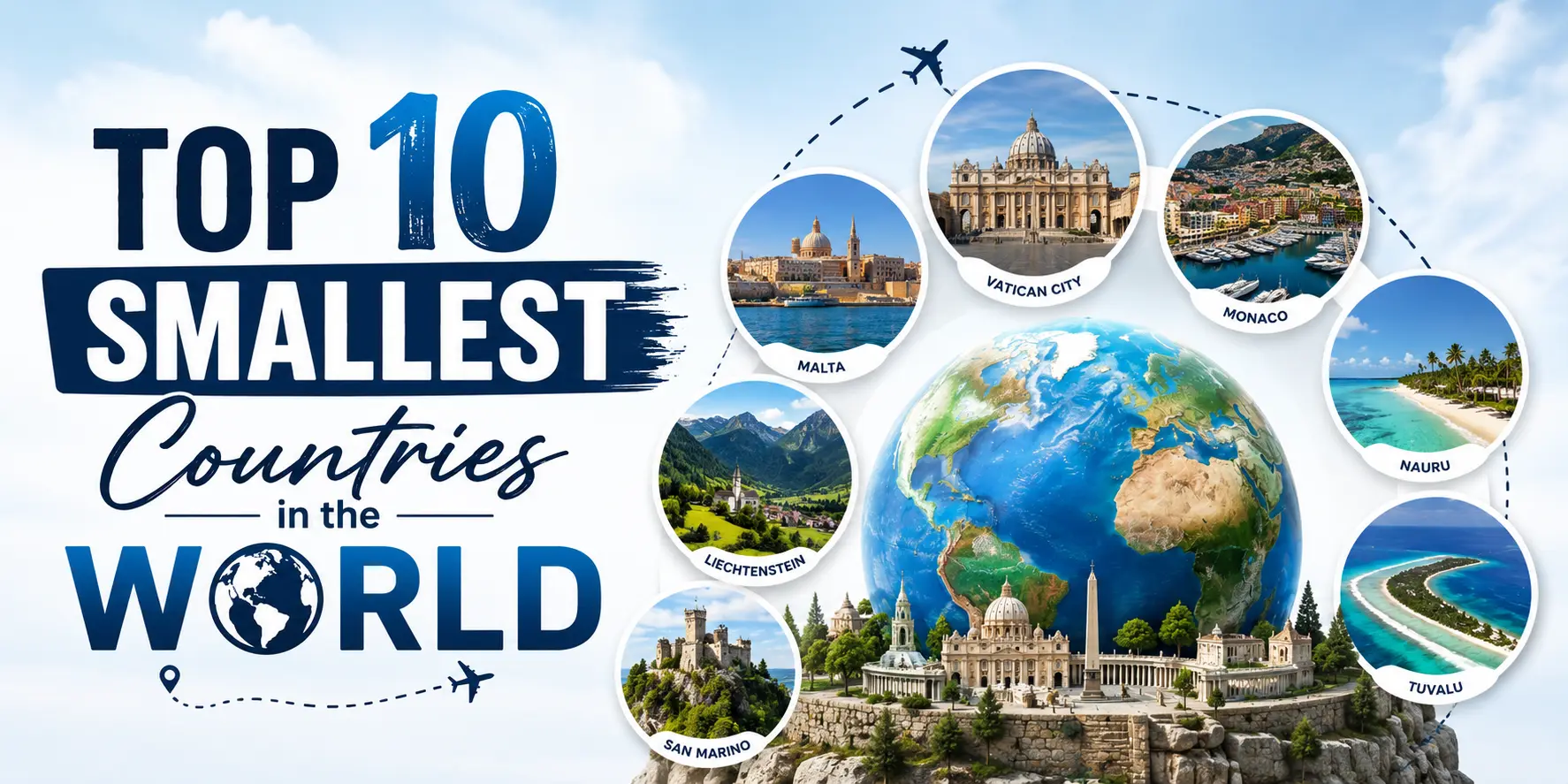
There are almost 200 countries in the world, from large countries such as Russia and Canada to very small micro states with an area of a few square kilometres. Although some of the world’s largest nations are certainly a topic of interest due to their size and power, some of the smallest countries in the world are no exception to the interest. The little countries are small in terms of land, but are very rich in tourism, culture, history and economy.
Here are some of the smallest countries in the world that are well-known for being places to visit, financial hubs, or historic religious sites. Some are island countries with clear waters, and others are countries where they are tucked away within larger countries. These are the smallest of countries and have their own governments, flags, traditions and identities.
In this article, we will discuss the top 10 smallest countries in the world as well as some interesting facts, history, and attractions that they have to offer.
Why Are Some Countries So Small?
Smallness is for many reasons, and there are many nations which have been small over the centuries. Geography often held them back in some instances. Some escaped due to political arrangements, to the importance of the trade, or to religious reasons. Many of the nations have their own distinctive economies revolving around tourism, banking or international relations.
Small countries tend to have:
Strong tourism industries
Unique cultural heritage
High population density
Limited natural resources
Strong diplomatic importance
Let’s now look at the smallest countries in the world.
1. Vatican City – The Smallest Country in the World
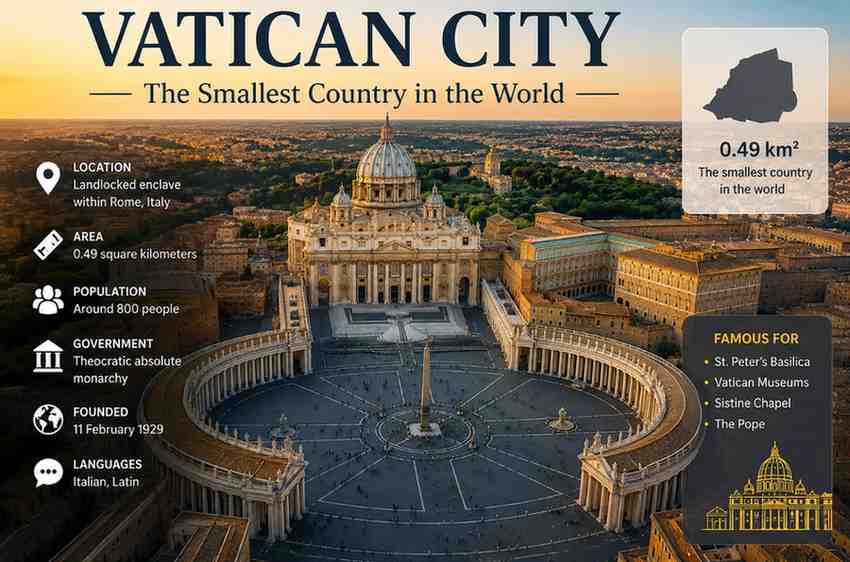
Area
0.49 square kilometers
Population
Around 800 people
Located inside Italy, Vatican City is officially the smallest country in the world. It serves as the spiritual and administrative center of the Roman Catholic Church and is home to the Pope.
Even though it is tiny, Vatican City is one of the most visited places on Earth. Millions of tourists travel here every year to admire its art, architecture, and religious importance.
Famous Attractions
- St. Peter’s Basilica
- Vatican Museums
- Sistine Chapel
- St. Peter’s Square
Interesting Facts
- It has its own postal service and radio station.
- Vatican City has no permanent hospitals or airports.
- It became an independent country in 1929.
2. Monaco – The Luxury Microstate
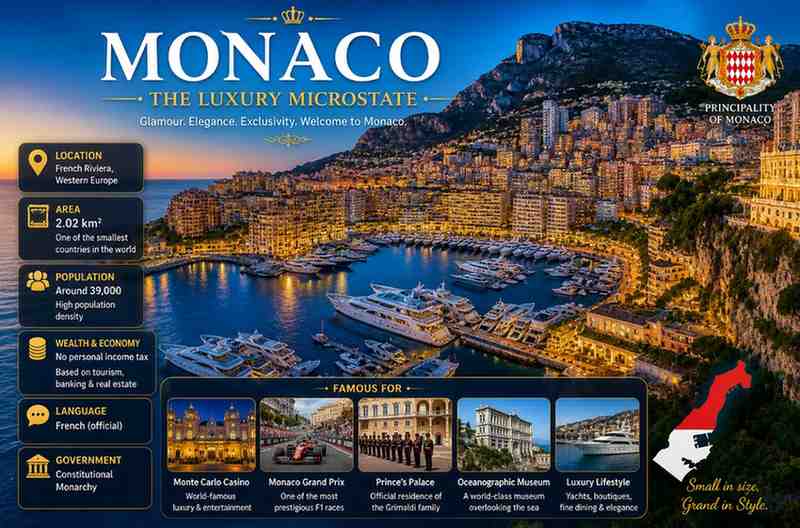
Area
2.02 square kilometers
Population
Around 39,000 people
Monaco is famous for luxury, casinos, yachts, and Formula One racing. Located on the French Riviera near France, Monaco is one of the richest countries in the world.
Despite its tiny size, Monaco attracts wealthy residents and tourists from around the globe.
Famous Attractions
- Monte Carlo Casino
- Monaco Grand Prix
- Prince’s Palace
- Oceanographic Museum
Interesting Facts
French is the official language.
Monaco has one of the highest population densities in the world.
There is no income tax for residents.
3. Nauru – The Smallest Island Nation
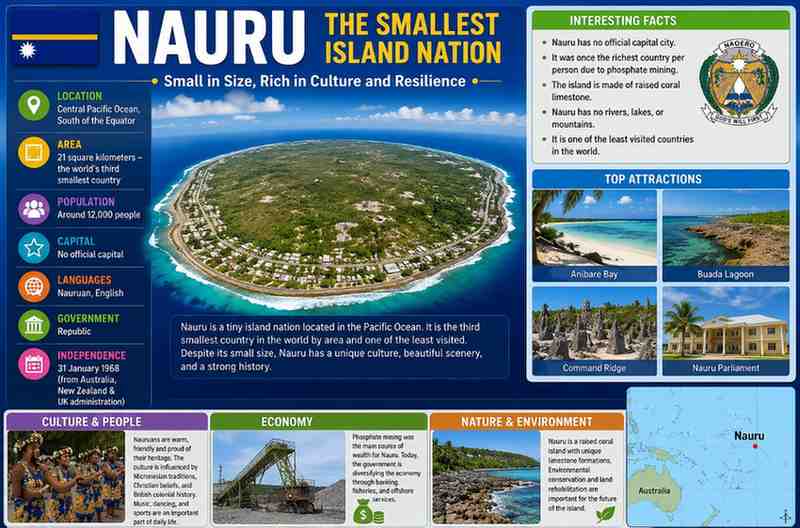
Area
21 square kilometers
Population
Around 12,000 people
Nauru is a tiny island country located in the Pacific Ocean. It is known for phosphate mining and beautiful ocean scenery. Nauru was once one of the richest countries per person because of its phosphate exports.
Today, the country faces environmental and economic challenges but remains culturally unique.
Famous Attractions
- Anibare Bay
- Buada Lagoon
- Coral reefs
- Coastal landscapes
Interesting Facts
- Nauru has no official capital city.
- It is one of the least visited countries in the world.
- English and Nauruan are commonly spoken.
4. Tuvalu – A Beautiful Pacific Nation
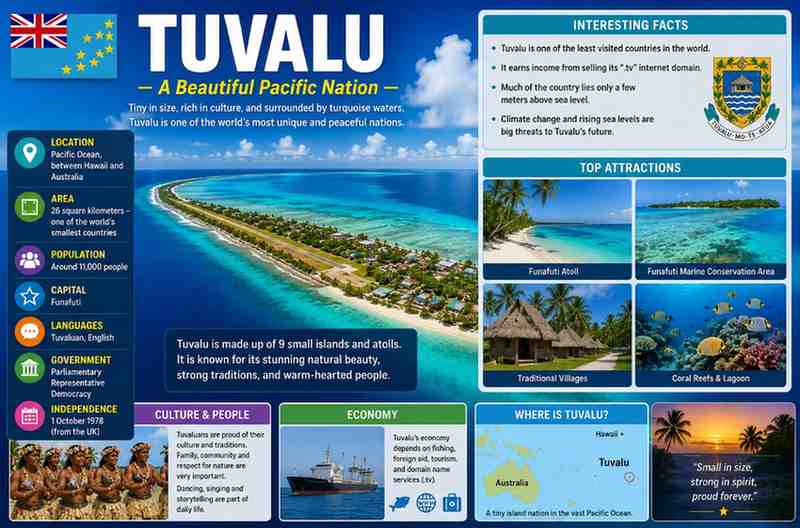
Area
26 square kilometers
Population
Around 11,000 people
Tuvalu is another small island nation in the Pacific Ocean. It is famous for its stunning beaches and traditional Polynesian culture.
Climate change and rising sea levels are major concerns for Tuvalu because much of the country lies only a few meters above sea level.
Famous Attractions
- Funafuti Marine Conservation Area
- Tropical lagoons
- Traditional villages
- Coral reefs
Interesting Facts
- Tuvalu earns income from its “.tv” internet domain.
- Fishing and agriculture are important industries.
- It is one of the world’s most remote countries.
5. San Marino – One of the Oldest Republics
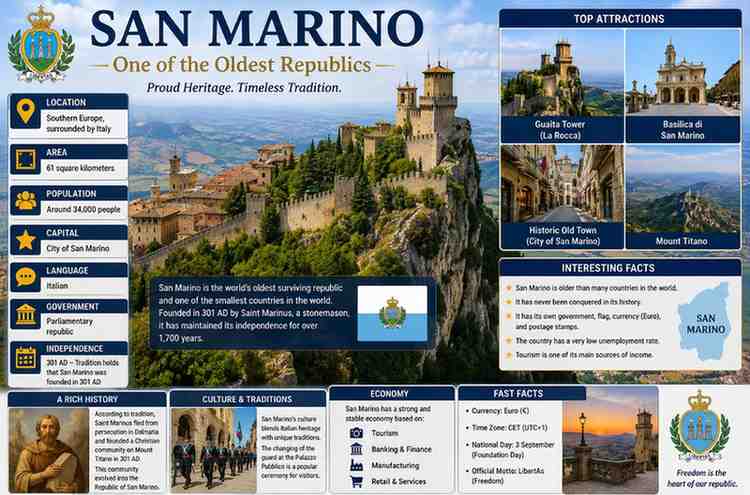
Area
61 square kilometers
Population
Around 34,000 people
Surrounded by Italy, San Marino is one of the oldest republics in the world. It is famous for medieval architecture, mountain scenery, and historic fortresses.
Tourism plays a major role in the country’s economy.
Famous Attractions
- Guaita Tower
- Basilica di San Marino
- Historic Old Town
- Mount Titano
Interesting Facts
- San Marino claims to be the world’s oldest surviving republic.
- It has its own football team and government.
- The country uses the euro currency.
6. Liechtenstein – The Alpine Treasure
Area
160 square kilometers
Population
Around 39,000 people
Located between Switzerland and Austria, Liechtenstein is a wealthy European country known for banking, mountains, and winter sports.
The country has beautiful Alpine scenery and a strong economy despite its small size.
Famous Attractions
- Vaduz Castle
- Alpine hiking trails
- Ski resorts
- Rhine Valley
Interesting Facts
- Liechtenstein has no airport.
- It is one of the richest countries per person.
- German is the official language.
7. Marshall Islands – A Pacific Paradise
Area
181 square kilometers
Population
Around 42,000 people
The Marshall Islands are located in the central Pacific Ocean. This island nation consists of coral atolls and islands surrounded by clear blue waters.
Fishing and tourism are important industries here.
Famous Attractions
- Bikini Atoll
- Majuro
- Diving sites
- Coral lagoons
Interesting Facts
- The United States conducted nuclear tests here in the past.
- English and Marshallese are official languages.
- The country is highly vulnerable to rising sea levels.
8. Saint Kitts and Nevis – Caribbean Beauty
Area
261 square kilometers
Population
Around 48,000 people
Saint Kitts and Nevis is the smallest country in the Western Hemisphere by both population and area. It is famous for tropical beaches, resorts, and Caribbean culture.
Tourism is the country’s main source of income.
Famous Attractions
- Brimstone Hill Fortress
- Pinney’s Beach
- Scenic railway tours
- Rainforests
Interesting Facts
- It gained independence in 1983.
- Cricket is a popular sport.
- English is the official language.
9. Maldives – Tropical Island Heaven
Area
298 square kilometers
Population
Around 520,000 people
The Maldives is one of the most famous tropical destinations in the world. Located in the Indian Ocean, it is known for luxury resorts, coral reefs, and crystal-clear waters.
Tourism drives the Maldivian economy.
Famous Attractions
- Luxury water villas
- Scuba diving
- Coral reefs
- Male City
Interesting Facts
- The Maldives consists of nearly 1,200 islands.
- It is the lowest-lying country in the world.
- Climate change threatens many islands.
10. Malta – The Historic Mediterranean Nation
Area
316 square kilometers
Population
Around 540,000 people
Located in the Mediterranean Sea, Malta is rich in history, culture, and tourism. The country has ancient temples, beautiful coastlines, and historic cities.
Malta has been influenced by many civilizations, including the Romans, Arabs, and British.
Famous Attractions
- Valletta
- Blue Lagoon
- Mdina
- Ancient temples
Interesting Facts
- Malta is one of Europe’s sunniest countries.
- English and Maltese are official languages.
- The country is famous for film shooting locations.
Table: Top 10 Smallest Countries in the World
| Rank | Country | Area | Population |
|---|---|---|---|
| 1 | Vatican City | 0.49 km² | 800 |
| 2 | Monaco | 2.02 km² | 39,000 |
| 3 | Nauru | 21 km² | 12,000 |
| 4 | Tuvalu | 26 km² | 11,000 |
| 5 | San Marino | 61 km² | 34,000 |
| 6 | Liechtenstein | 160 km² | 39,000 |
| 7 | Marshall Islands | 181 km² | 42,000 |
| 8 | Saint Kitts and Nevis | 261 km² | 48,000 |
| 9 | Maldives | 298 km² | 520,000 |
| 10 | Malta | 316 km² | 540,000 |
Small countries face a variety of challenges.There are various challenges in small countries.
Beautiful and unique, these countries have a lot of problems to address.
Limited Natural Resources
There are many small countries that have no large forests, rivers or minerals. This could lead to reliance on imports.
Climate Change
Rising sea level is a threat to island nations such as Tuvalu and Maldives.
Economic Dependence
Tourism and banking or a single industry are often a major source of revenue for small countries.
Population Pressure
Monaco is one of the countries with high population density because of its small size.
The reasons that tourists love small countries.
Small countries tend to be easier to explore, and provide some unique travel experiences. Tourists enjoy:
Beautiful beaches
Historic architecture
Luxury resorts
Unique local cultures
Peaceful environments
These countries are popular destinations for those seeking adventure, relaxation, and cultural experiences.
Interesting information about the smallest countries.
Vatican City is the size of many shopping malls.
Monaco is a place where millionaires reside and luxury cars are what are made.
Maldives is among one of the world’s leading honeymoon destinations.
San Marino has been around for over 1,700 years!
Tuvalu makes millions of dollars from its “.tv” domain.
Conclusion
Smallest countries in the world show that size does not equal importance! These small countries are teeming with history, beauty, culture and world significance. Each of the countries is distinctive; from the religious capital of Vatican City to the luxury way of life in Monaco and the tropical splendor in the Maldives.
From a local tour to a fascination with geography, history or culture, it is alluring to learn more about the smallest countries in the world. Although smaller than some others in the map, these countries make a large impact on those who visit and the rest of the world.